
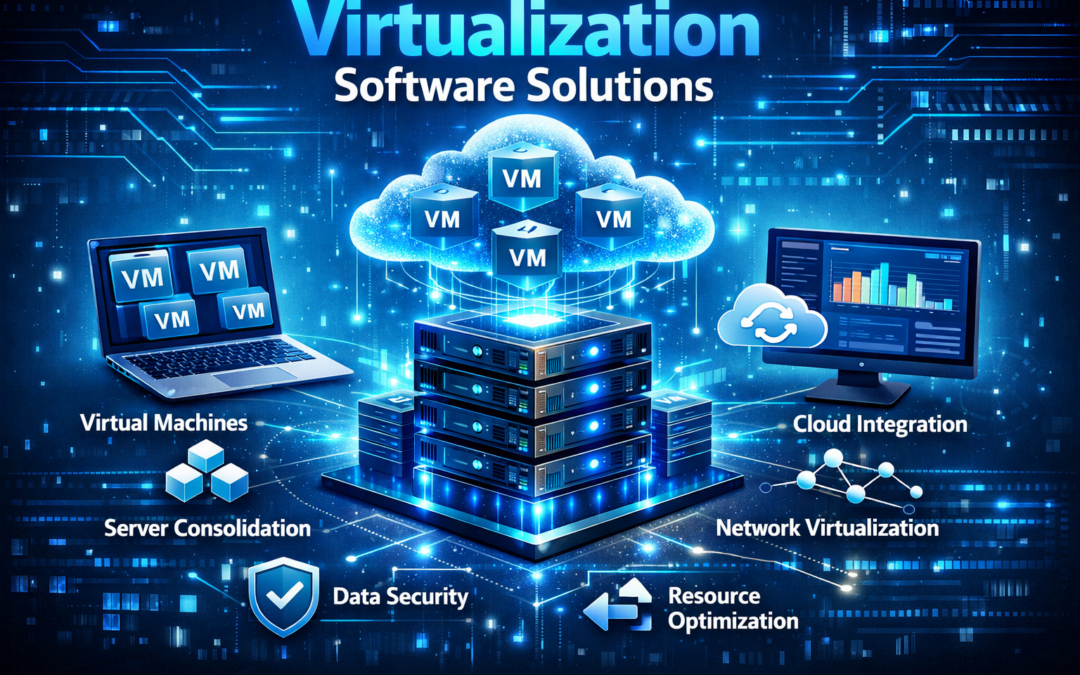
In the fast-evolving world of IT infrastructure, virtualization software stands as a game-changer. It empowers businesses and individuals to maximize hardware efficiency, scale operations seamlessly, and innovate without boundaries. This blog dives deep into what virtualization software is, how it operates, and why it remains essential in 2026’s digital landscape. Whether you’re optimizing servers or experimenting with cloud setups, understanding this technology unlocks new potentials.
Furthermore, as demands for remote work, AI workloads, and hybrid clouds surge, virtualization software solutions deliver the flexibility needed to thrive. Let’s embark on this journey through its layers, starting with the fundamentals.
Genesis of Virtual Worlds:
Virtualization software creates virtual versions of computing resources, such as servers, storage, or networks, from physical hardware. It acts like a masterful illusionist, dividing one machine’s power into multiple isolated environments that run independently. Consequently, organizations slash costs and boost agility without purchasing extra gear.
Moreover, this technology abstracts hardware complexities, allowing users to manage resources dynamically. For instance, a single server might host dozens of virtual machines (VMs), each mimicking a full computer system. As IT infrastructures grow more complex, virtualization software solutions emerge as indispensable tools for efficiency.
Architectural Alchemy:
At its heart, virtualization software relies on a hypervisor the magical conductor orchestrating everything. Type 1 hypervisors run directly on hardware, like VMware ESXi or Microsoft Hyper-V, delivering raw performance for enterprise needs. Meanwhile, Type 2 hypervisors, such as VirtualBox, layer atop an existing OS, suiting developers testing apps on desktops.
Guest operating systems and virtual hardware further complete the puzzle. The hypervisor emulates CPUs, RAM, and disks for each VM, ensuring isolation via techniques like memory ballooning and shadow paging. Therefore, crashes in one VM rarely ripple to others, safeguarding stability.
Hypervisor Symphony:
The hypervisor actively intercepts hardware calls from VMs, translating them into physical actions. When a VM requests CPU time, the hypervisor schedules it across available cores using algorithms like round-robin or credit-based scheduling. This dynamic allocation prevents resource hogging, ensuring fair play.
Additionally, features like live migration transfer running VMs between hosts without downtime, a boon for maintenance. Consequently, businesses maintain 99.99% uptime, even during upgrades. Virtualization software solutions like KVM integrate seamlessly with Linux kernels, amplifying open-source power.
From Bare Metal to Digital Clones:
Creating a VM starts with installing the hypervisor on physical hardware. Administrators then allocate resources—say, 4GB RAM and 2 vCPUs—via intuitive dashboards. Next, they boot an ISO image of an OS, like Ubuntu or Windows, which installs as if on dedicated iron.
Once live, the VM operates indistinguishably from physical servers, running apps and services. Tools monitor performance, auto-scaling resources as loads spike. Thus, virtualization software transforms static hardware into a responsive ecosystem.
Resource Wizardry:
Virtualization software excels at pooling resources intelligently. It overcommits CPU and memory, provisioning more virtual resources than physically available, banking on average utilization rates below 100%. Balloon drivers inside VMs relinquish unused memory on demand, freeing it for others.
Storage virtualization layers in, pooling disks into shared datastores with thin provisioning allocating space only as needed. For example, a 100GB virtual disk might use just 10GB initially. This efficiency drives up to 80% hardware utilization, per industry benchmarks from Gartner.
Networking Nebula:
Virtual switches bridge VMs to physical networks, enabling VLANs and firewalls within software. SDN (Software-Defined Networking) integrations, like those in VMware NSX, route traffic dynamically based on policies. Therefore, admins deploy secure micro-segmentation without hardware overhauls.
Load balancers distribute traffic across VM clusters, enhancing resilience. In containerized setups, tools like Docker complement by virtualizing at the app level, lighter than full VMs. Meanwhile, hybrid clouds blend on-prem virtualization with AWS or Azure for burst capacity.
The Power Pantheon:
Leading virtualization software solutions dominate the market. VMware vSphere rules enterprises with robust clustering and vMotion for seamless migrations. Microsoft Hyper-V integrates natively with Windows Server, appealing to Azure-bound firms.
Open-source stars like Proxmox VE and oVirt offer cost-free alternatives with web-based management. Nutanix AHV hyper-converges compute, storage, and networking into one stack. Each shines in niches: KVM for Linux purists, Oracle VM for database heavyweights. Selecting the right one hinges on scale, budget, and ecosystem fit.
Triumphs in the Trenches:
Companies worldwide harness virtualization to slash costs dramatically. Netflix virtualizes its streaming infrastructure on AWS, auto-scaling thousands of VMs during peak hours. A mid-sized UK retailer, facing data center sprawl, consolidated 50 servers into five via Hyper-V, cutting energy bills by 70%.
Healthcare providers virtualize EMR systems for HIPAA-compliant isolation. Consequently, downtime plummets, and scalability soars. These triumphs underscore how virtualization software solutions fuel digital transformation.
Shadow Side Unveiled:
No technology lacks hurdles; virtualization introduces overhead from hypervisor layers, potentially capping performance at 5-10% loss. “VM escape” vulnerabilities, though rare, demand vigilant patching. Licensing costs for proprietary tools can sting small outfits.
Yet, mitigations abound: right-size VMs to avoid sprawl, embrace containers for microservices, and monitor with tools like Prometheus. Thus, informed strategies turn pitfalls into power-ups.
Future Frontiers:
Looking to 2026 and beyond, virtualization merges with edge computing for IoT deployments. AI-driven orchestration, via projects like Kubernetes with KubeVirt, automates VM lifecycles intelligently. Quantum-resistant encryption bolsters security amid rising threats.
Serverless paradigms and WebAssembly push boundaries, virtualizing functions over full OSes. Therefore, virtualization software solutions evolve into omnipresent enablers of zero-trust architectures.
Your Launchpad:
Start small: download VirtualBox for desktop experiments, then scale to Proxmox on a home lab server. Assess needs—enterprise? Go vSphere. Budget-tight? KVM beckons. Train via free certs like VMware’s VCA.
Monitor ROI with metrics like VM density and TCO reductions. In essence, virtualization software propels IT from rigid to revolutionary.


