
Navigating the logistics of global e-commerce means wearing many hats. You are a marketer, a customer service representative, and a product designer all at once. But when your business expands across borders, you suddenly have to become a mathematician, too.
The division between countries using the imperial system and those relying on the metric system is one of the most common friction points in global logistics. If your product listings or shipping manifests confuse these systems, it can result in unexpected customs fees, rejected shipments, or disappointed customers.
At the center of this headache is a seemingly simple calculation: converting grams in an ounce. Mastering this minor math problem is a fundamental step toward building a seamless international shipping workflow.
How Many Grams in 1 Ounce?
When you are shipping goods globally, guessing weight is a fast track to losing money. To keep your logistics accurate, you need to know the precise conversion standard.
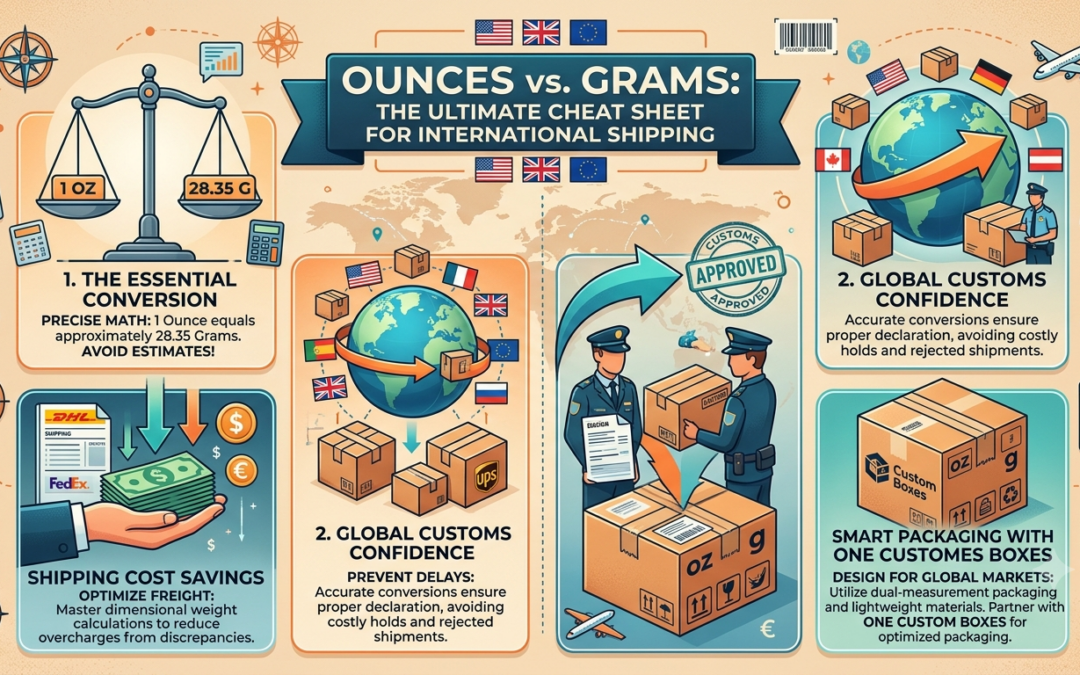
There are exactly 28.35 grams in one standard (avoirdupois) ounce.
To turn ounces into grams, multiply your ounce value by $28.35$. If you are working in reverse, divide your gram total by $28.35$ to find the ounces.
Quick Reference Guide for Packaging Scales
For quick mental math on the warehouse floor, you can round this number to 28 grams. However, when printing digital shipping labels or calculating bulk freight, relying on that fractional $.35$ is critical. Let’s look at how these numbers scale up as your packages get heavier:
| Weight in Ounces (oz) | Exact Weight in Grams (g) | Common Shipping Application |
| 1 oz | 28.35 g | Jewelry, cosmetic samples, small stickers |
| 2 oz | 56.70 g | Luxury serums, essential oils, enamel pins |
| 4 oz | 113.40 g | Gourmet spices, e-commerce apparel accessories |
| 8 oz | 226.80 g | Premium coffee bags, candles, small electronics |
| 16 oz (1 lb) | 453.59 g | Wholesale items, structural retail packaging |
Why 0.35 Grams Can Derail Your Global Supply Chain
If you are only mailing a single letter or a lightweight document, a fraction of a gram won’t change your postage rates. But in commercial fulfillment, tiny discrepancies compound incredibly fast.
Consider a cosmetic brand exporting a shipment of 5,000 premium glass tincture bottles. If the fulfillment team rounds the weight down and counts each ounce as a flat 28 grams, they are missing $0.35$ grams per ounce. Across a massive bulk shipment, that calculation error can throw off the entire freight manifest by several kilograms.
When a customs officer or an international carrier verifies the cargo weight at a border checkpoint, a mismatched manifest can flag your shipment for an audit. This leads to:
- Unexpected storage or handling fees at port terminals.
- Extended customs holds that delay delivery dates by weeks.
- Overcharges on dimensional weight assessments from carriers like DHL, FedEx, or UPS.
Designing for Global Fulfillment: Smart Packaging Decisions
Experienced exporters know that successful international shipping starts long before an order hits the scale. It begins during the structural product design phase.
When you create packaging with global distribution in mind, it is always smart to display both metric and imperial measurements on the external carton. This builds immediate trust with international customs officials and consumers alike.
Furthermore, optimizing the dry weight of your packaging material is an easy way to protect your profit margins. Swapping out heavy rigid materials for lightweight, structural cardboard or minimalist mailers can shave a few ounces off your total package weight. If you can keep a parcel just under a critical carrier weight threshold—such as the 100-gram or 250-gram mark used by many international postal services—you will unlock significantly cheaper shipping tiers.
Best Practices for Frictionless Cross-Border Logistics
To prevent weight discrepancies from eating into your bottom line, consider implementing these simple operational updates:
1. Standardize Your Digital Infrastructure
Do not leave weight conversions up to manual math. Ensure your e-commerce platform, inventory management software, and shipping software are fully synced. Most modern shipping systems allow you to input product weights down to the exact decimal point, ensuring that automated customs forms generate the correct metric values.
2. Invest in Dual-Mode Digital Scales
Equip your fulfillment station with a calibrated digital scale that switches between ounces and grams at the press of a button. When checking an international order, weigh the final, sealed package in grams to ensure it matches the metric weight stated on the commercial invoice.
3. Account for the Weight of the Box
A common mistake is weighing only the item itself. A sturdy shipping box, packing paper, protective bubble wrap, and even the shipping label add weight. Always calculate your shipping costs based on the total gross weight of the packed box, not just the net weight of the product inside.
Final Thoughts
Growing a business globally requires an eye for detail. While memorizing how many grams in 1 ounce feels like a minor detail, it represents the exact type of operational precision that sets top-tier e-commerce brands apart.
By prioritizing precise conversions, designing efficient packaging, and setting up automated systems with One Custom Boxes, you protect your shipments from costly customs bottlenecks. Keep this cheat sheet handy, calibrate your scales, and step into the global marketplace with confidence.


