
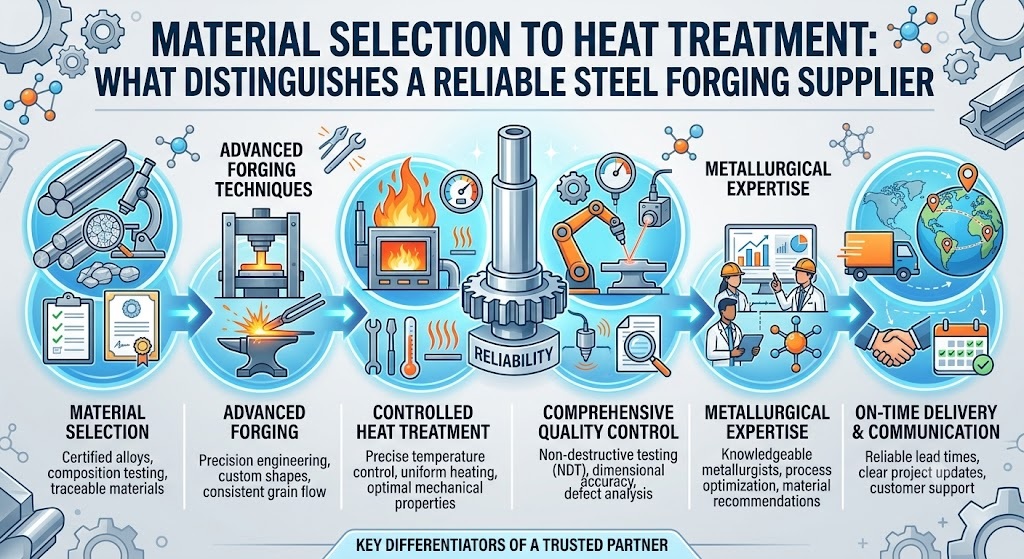
Pull the fracture surface of a cross shaft that failed at 85,000 km and the beach marks tell you the crack initiated subsurface, roughly 8mm below the spline runout radius. That’s not a design failure — the design had 4340 alloy steel with 30 HRC minimum core hardness and the fracture location has exactly the stress concentration geometry the designer put margin against. Run a microhardness traverse from surface to core on the fracture section and the picture changes: surface at 53 HRC, correct; 5mm depth at 41 HRC, not correct; 8mm depth at 29 HRC, just inside the drawing minimum. The crack initiated at the hardness transition zone because the quenching operation produced a hardness gradient steeper than the design assumed — the design assumed a through-hardened section with a gradual taper, the quench delivered a case-and-core profile more appropriate to a surface-hardened component. Same steel grade on the certificate. Same nominal composition. Different quench severity, different agitation, different result.
This is what choosing a steel forging supplier on grade and dimension alone produces, eventually. The failure was in the process, not the material.
Grade Selection and What It Actually Controls
The hardenability question is where most material specification errors originate, and hardenability is one of those properties that gets referenced constantly in metallurgical discussions without its practical consequences being traced through to what they mean at a specific cross-section. Hardenability describes the depth to which a grade can be hardened during quenching — governed quantitatively by the Jominy end-quench curve, which maps hardness against distance from the quenched end of a standardised 25mm diameter bar. A 4140 bar at 50mm cross-section oil-quenched achieves approximately 50–52 HRC at the surface but drops to 32–36 HRC at the centre, because the thermal gradient at the core of a 50mm section is insufficient to suppress pearlite and bainite transformation during cooling. 4340 at the same section oil-quenched achieves 54–56 HRC surface and 48–52 HRC core — the nickel content (1.65–2.00%) and molybdenum (0.20–0.30%) retard the transformation kinetics enough to allow martensite formation at the lower cooling rates that exist at the centre of a 50mm bar.
For a cross shaft with a 45mm minimum section where the design specification requires 28 HRC minimum through-section hardness, 4140 fails to meet the core requirement at that geometry. A steel forging supplier who substitutes 4140 for 4340 on a 45mm cross shaft because both grades are in stock and the surface hardness after quenching meets the drawing callout has produced a part that passes every outgoing inspection and fails bending fatigue life by 30–40% at the core. The certificate is correct. The part is wrong.
Carbon content within a single grade creates a secondary but consequential variation. The 4340 specification runs carbon at 0.38–0.43%, and a heat at the lower boundary of 0.38% achieves 3–4 HRC less surface hardness after identical quenching than a heat at 0.43%. For a component targeting 52 HRC surface hardness, a low-carbon heat needs either more aggressive quench media or longer time at austenitising temperature to build the carbon supersaturation in austenite that produces the target martensite hardness after quenching. A steel forging supplier who doesn’t run incoming Spectro PMI on every billet heat doesn’t know which end of the carbon range the current production batch came from until the hardness readings come back from the first furnace load.
Where Billet Quality Sits in the Defect Probability Chain
Roughly 60% of finished forging quality variation in a controlled production environment traces back to incoming billet, not to forging or heat treatment. This is consistently underestimated because billet defects — centreline segregation, subsurface seams, internal porosity from rolling — don’t declare themselves during forging or at dimensional inspection. They redistribute under compressive force and concentrate at locations that happen to coincide with the highest-stress zones in the finished component geometry.
A centreline discontinuity at 20% of bar diameter in a 60mm 4340 bar can pass the mill’s rolling inspection and produce a subsurface void at the shaft centreline after upsetting — sitting at the maximum shear stress location in torsion, invisible on OD measurement or surface hardness testing. The void doesn’t appear until the fatigue crack runs out to a diameter large enough to reduce the remaining section below its load capacity. Catching it requires incoming UT per ASTM A388 — straight-beam probe at 2.25 MHz or 5 MHz, full-length bar scan — before the first saw cut. At ₹300–500 per bar against the downstream cost of processing a full batch of safety-critical drivetrain components to finished parts on defective billet, the calculation isn’t close.
A Spectro PMI check at incoming — ₹150–200 per heat number — catches grade substitutions that arrive with plausible mill certificates. In a commodity steel stockist’s inventory, 1045 and 4140 bar sit in adjacent bins and both overlap at 190–220 HB as-normalised, which means the substitution survives every incoming check until quench-and-temper, when 1045 tops out at 42–44 HRC against the 52–56 HRC the drawing specifies — after forging, normalising, rough machining, and a full heat treatment cycle have been completed on the entire batch.
Forging Temperature, Reduction Ratio, And the Microstructure Forging Builds
The mechanical properties a heat treatment cycle develops in a steel forging are bounded by the microstructural starting condition the forging operation delivers, and that condition is set by three variables that a reliable steel forging supplier controls explicitly.
Forging reduction ratio — billet cross-sectional area divided by finished forging cross-sectional area — governs grain refinement. Below 3:1, grain structure is partially worked and impact toughness of the normalised forging runs 15–20% below what the same grade achieves at 4:1 or higher. The practical failure point is billet sizing discipline: the production floor tendency to use whatever diameter stock is available rather than the size the process plan specifies reduces the actual reduction ratio without triggering any visible alarm, and leaves a coarser grain structure going into heat treatment than the process was validated on.
Finish forging temperature governs grain size entering normalising. Austenite grain coarsening accelerates above 1,150°C, and material struck at high temperature enters normalising at ASTM grain size below 6 rather than the target 7–8 for automotive alloy steel work. Fine pearlite at grain size 7–8 responds to austenitising with faster, more complete carbide dissolution at 830–845°C and produces a more uniform martensite lath structure on quenching. Grain at size 5–6 leaves undissolved carbide clusters at prior austenite grain boundaries that become crack initiation sites under alternating torsional or bending stress. The control is a process alarm at the forge station pyrometer — not an operator temperature log filled in hourly.
Post-forge cooling rate is the variable most consistently overlooked. A 4340 forging that air-cools rapidly in a draught from the press to the normalising furnace entry develops a partially martensitic surface skin over a ferritic-pearlitic core — a mixed microstructure that a single normalising cycle won’t fully homogenise. The result is 15–25 HB variation through the cross-section that propagates through the quench-and-temper response, distributing finished hardness non-uniformly across a cross-section that reads within the 28–34 HRC drawing callout on a spot Brinell check because the indentation, at 10mm impression diameter, averages across the mixed microstructure without resolving it.
Heat Treatment Variables That Decide Everything After the Forge Floor
The table below covers the governing heat treatment parameters for the alloy steel grades that dominate steel forging supplier production for automotive drivetrain and structural applications. The numbers aren’t reference values — they are the specific process targets, deviations from which produce the failure modes listed.
Before the table: one observation worth making explicit. Temperature uniformity surveys (TUS) per AMS 2750 define a furnace working zone as the volume where temperature holds within ±10°C or ±14°C of setpoint. A furnace without a TUS in the last 12 months can have a hot zone exceeding 845°C at the centre and a cold zone below 830°C near the door loading at a 15°C setpoint window — producing mixed microstructures within a single load that post-treatment Brinell testing won’t resolve because the 10mm indentation diameter averages local variation rather than detecting it.
| Steel Grade | Austenitising Temp | Quench Media | Temper Range | Core Hardness Target | Out-Of-Control Failure Mode |
| 4140 (42CrMo4) | 840–860°C | Oil, 40–70°C | 550–650°C | 28–34 HRC | Low core hardness at section >40mm |
| 4340 (34CrNiMo6) | 830–845°C | Oil, 40–60°C | 540–640°C | 30–36 HRC | Hardness gradient steeper than design at quench temp drift |
| 20MnCr5 (carburised) | Carburise 920°C, harden 820°C | Oil, 40–60°C | 160–180°C | 28–34 HRC core, 58–62 HRC surface | Case depth variation from carbon potential drift ±0.05% |
| EN36 (17CrNiMo6) | Carburise 930°C, harden 820°C | Oil, 40–60°C | 160–180°C | 32–38 HRC core | Non-uniform case at overloaded furnace charge density |
| 1045 (C45) | 820–840°C | Water or polymer | 550–650°C | 20–28 HRC | Quench cracking at spline or keyway transitions |
Oil quench agitation is the parameter that most often gets underdocumented. Quench severity runs at H-value 0.35 for still oil and 0.7 for well-agitated oil — and a 4340 shaft at 40mm diameter quenched in still oil at 60°C achieves approximately 50 HRC against 54–56 HRC in well-agitated oil at 40°C. Production batches where the quench tank temperature drifts from 40°C to 65°C across a shift — a ±12°C thermostat deadband on a tank that isn’t monitored against oil volume — produce a hardness spread that spans the 28–34 HRC specification range without a single out-of-tolerance individual piece, while the mean and standard deviation of the batch shift in a way that concentrates lower hardness values at the exact cross-sections where the fatigue life calculation sits tightest.
Sendura Forge Pvt. Ltd., certified to IATF 16949:2016 and ISO 9001:2015, operates as a steel forging supplier from Rajkot with belt-drop hammer capacity from 1 to 3 tons, 800 metric tonnes monthly production capacity, and over 700 part numbers in production — gear blanks, helical gear and shaft assemblies, cross shafts, ring gear carriers, balancing shafts, counter shafts, and coupling flanges in 4140, 4340, 20MnCr5, and EN series grades — for customers including DANA, Mahindra, Eaton, Escorts, WABCO, New Holland, TAFE, Bonfiglioli, RSB, and Setco, with in-house Spectro PMI, ultrasonic billet inspection, and the full heat treatment and QA/QC infrastructure the grade-level process control described here requires.
Conclusion
The cross shaft that failed at 85,000 km in the opening of this article came from a supplier whose certificate was correct, whose dimension was correct, and whose process was undocumented at the quench agitation stage. It didn’t fail because anyone made a deliberate decision to cut corners. It failed because the quench tank temperature wasn’t monitored against a process limit, the hardness gradient consequence of that temperature drift wasn’t in anyone’s PFMEA, and by the time the field failure surfaced, the production batch that caused it was three months in the past and the process record that would have explained it didn’t exist.
A reliable steel forging supplier doesn’t distinguish itself by avoiding that failure on the qualification batch. It distinguishes itself by having the process controls in place — Spectro PMI at incoming, TUS-verified furnaces, documented quench agitation monitoring, reduction ratio tied to billet size specification — that make the failure impossible to generate silently across a production run. The component that passes first-article inspection passes it because the process was correct at every preceding stage. And a steel forging supplier whose process is correct at every preceding stage produces the same result at the 40,000th piece that it produced at the first, which is the only version of quality that matters once a program moves to volume.


