
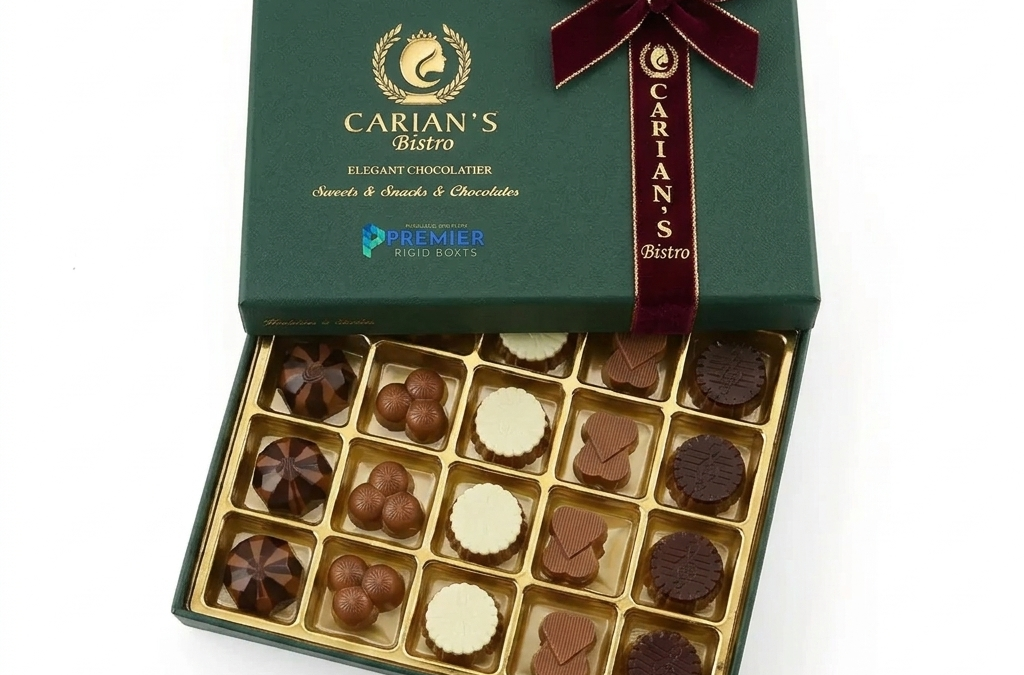
When you begin to shop custom candy boxes wholesale, one of the questions you will be asked is what is the minimum order quantity often known as MOQ. This figure may differ significantly among the manufacturers, and knowing the reasons as to why this is so, will save you time and money. No matter whether you require some basic folding cartons to pack up a small production of artisan caramels or the fancy rigid candy boxes to fit a premium chocolate brand, the MOQ guides all other choices you will make.
What MOQ Means in Packaging
Minimum order quantity is the quantity that a manufacturer must produce per order. The reason behind its existence is that packaging production entails set up costs. A manufacturer has to design printing plates, program cutting dies, blend inks, and calibration equipment before a single box is printed. These procedures are time and labor-consuming. The cost per box would be outrageous were a manufacturer to have been given an order of ten boxes. The manufacturer can distribute those fixed costs by establishing an MOQ, to the extent that it will be economically viable to both parties to produce the item.
In the case of custom candy boxes, the MOQs can be divided into three general categories. The range of low MOQs begins at 100 to 500 units and is commonly provided by digital printers or smaller packaging experts. Mid-range MOQs are between 500 and 3,000 units and that is the sweet spot of many developing candy brands. High MOQs of 5,000 to 10,000 units or more come from large-scale offset printers and metal packaging manufacturers.
Minimal MOQ with Small Batches
In the case of small candy companies, seasonal products, or test products, it is necessary to find a supplier with a low MOQ. Candy boxes with minimums as low as 100 candy pieces are now being offered by some packaging companies. This gives a chocolatier the freedom to design a unique packaging on Valentine day without the need to invest in thousands of boxes which may not be used up.
Low MOQs are now accessible due to the digital printing technology. Digital printing, as opposed to a conventional offset printing, does not need expensive plates to use but rather transfers the design onto the box material. This does away with plate costs and renders shorter runs cost-effective. Digital printing, however, might lack color matching and finishing options to offset printing.
In the case of rigid candy boxes, which are made of denser materials and require more complicated assembly, low MOQs are not as widespread but can be found. There are manufacturers who supply rigid boxes in 100 unit batches, but will not customize the size further except to standard sizes with foil stamping or plain printing, as opposed to a completely customized shape.
Box Standard MOQ Ranges
The kind of candy box you use greatly influences the minimum order quantity. The most popular form of cartons used in everyday candies such as mints, caramels, and wrapped chocolates are made of paperboard in the form of folding cartons that usually have 500 to 2,000 units as MOQs. These boxes are cut out of flat sheets, and folded into shape, which is a fairly efficient operation.
Rigid candy boxes: also known as setup boxes
Custom rigid candy boxes are made of thick chipboard with printed paper. These are the boxes you would see of the high-end chocolates or the gift assortments. Since rigid boxes are more labor intensive and demand special tools, MOQs tend to be high. Many rigid box manufacturers set their minimum at 500 to 1,000 pieces. The wrapped and thicker board construction just does not work very well with very small runs.
Candy tin boxes are a different breed. Metal packaging involves using special tools to make each shape and size, which are costly to develop. As a result, the tin box MOQs are significantly greater, with the initial ones typically being 3,000 to 5,000 units. Other manufacturers sell stock tin sizes with custom printing at lower minimums, but fully custom-shaped tins need large volumes to warrant the investment in the tooling.
Reason why manufacturers have different MOQs
There are a number of reasons as to why one supplier may offer 100 boxes and the other offers 5,000. The major factor is production method. The cost of setting up digital printers is low and therefore it can make profits at very low volumes. The offset printers are very expensive to set up but less expensive at volume. A manufacturer that has Heidelberg offset presses will have a higher MOQ since the equipment is engineered to be used in long runs.
The geographic location is a factor as well. In areas where labor is cheaper, manufacturers might provide more flexible MOQs since hand-assembly activities are cheaper. Nevertheless, a larger amount of shipping in smaller quantities to foreign countries can nullify those savings in freight expense.
How to Find the Right MOQ for Your Brand?
Get to know your requirements before going to any supplier. Estimate the number of candy boxes that you will actually utilize in half a year. Additional ordering of boxes could reduce the unit price, but unutilized boxes occupy storage space and capital is tied up.
When introducing a new candy, you may want to adopt a low MOQ supplier despite a higher unit cost. The capability to test the market by having 250 boxes instead of investing in 5,000 is worthwhile. After you have verified demand, you can switch to a manufacturer with higher volumes to run on new orders. It can be beneficial to order several box styles at once. Assuming that you require three designs of candy boxes, one of the manufacturers may accept fewer candy boxes per design as long as the overall order satisfies their MOQ. MOQ can also be affected by payment terms. Making an offer to pay a higher percentage upfront or to pay the tooling separately may persuade a manufacturer to accept a smaller run at the start.
At Premier Rigid Boxes, we specialize in crafting custom rigid packaging that delivers both luxury and lasting quality for brands across the USA. Our focus is exclusively on rigid setup boxes, allowing us to master every detail, we provide fully customizable solutions with low minimum order quantities at wholesale rates.
Cost Trade-Off of Low MOQs
Reduced MOQ practically always equates to an increase in price per box. The fixed costs are yet to be covered by the manufacturer hence the costs are allocated among a lesser number of units. As an illustration, a 100-unit order of personalized candy boxes may end up costing 2.00 per box, whereas a 1,000-unit order of the same box may cost 0.80 per box.
This is not a penalty trade-off. It just mirrors the economics of production. The trick lies in aligning the MOQ with your current business level. A startup that sells at local farmer’s markets does not require 10,000 boxes. A national candy brand that delivers to large retailers cannot work with minimum orders of 100-box.


