
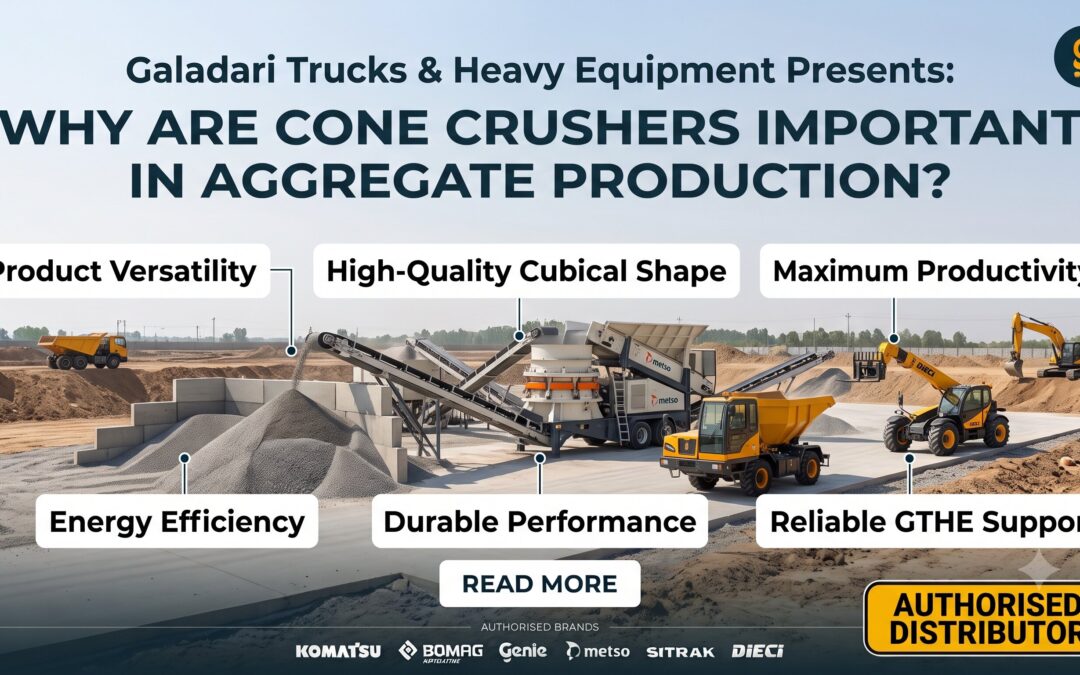
In modern quarrying and mining operations, a cone crusher isn’t just another piece of equipment—it’s the backbone of consistent, efficient aggregate production. From highway construction to concrete manufacturing, the uniformity and quality of crushed stone depend heavily on choosing the right crushing technology and operating it effectively.
The aggregate industry moves billions of tonnes of material annually. Behind every cubic metre of uniform crushed stone or gravel sits a carefully engineered crushing process. A cone crusher plays a pivotal role in that process, transforming raw ore and oversized rock into precisely sized product that meets customer specifications and industry standards.
Understanding How Cone Crushers Work
A cone crusher operates on a simple but elegant principle: a rotating spindle with an eccentrically mounted crushing cone works against a fixed concave mantle. As material enters the crushing chamber, it gets squeezed between these two surfaces with enormous force—enough to pulverize rock but precise enough to produce consistent sizing.
The real genius of a cone crusher lies in its geometry and speed. Unlike jaw crushers (which perform primary crushing on larger feed), cone crushers excel at secondary and tertiary crushing stages. They can handle material that’s already been partially reduced, crushing it to the exact specification required for final product.
The adjustable bottom opening—which can be widened or narrowed—gives operators direct control over the final product size. Tighten it and you get finer material; widen it and throughput increases. This flexibility is critical in aggregate operations where customer demands shift and product specifications vary.
Consistent Material Sizing: The Heart of Quality Control
One of the most demanding aspects of aggregate production is delivering consistent product sizing. Customers expect their crushed stone to meet tight specifications—whether that’s 20-40mm, 10-20mm, or crusher dust. Variation isn’t just a quality issue; it’s a financial one. Oversized material gets rejected; undersized material wastes resources.
A cone crusher’s design minimizes variation. The closed circuit configuration—where crushers work alongside screens that separate material by size, recycling oversized pieces back through the crusher—ensures that very little out-of-spec material leaves the system. This creates several advantages:
🎯
Tight Size Distribution
Achieves narrow particle size ranges that meet customer specifications consistently
✓
Reduced Waste
Fewer out-of-spec fines or oversize particles means less material loss
💰
Higher Sellable Yield
More of the crushed material meets customer standards without rework
📊
Predictable Output
Consistent product lets you plan production schedules with confidence
This consistency matters enormously in ready-mix concrete plants, asphalt operations, and infrastructure projects. A variation of just 10mm in aggregate sizing can compromise concrete strength or make asphalt workability unpredictable. Cone crushers eliminate that guesswork.
Productivity and Throughput Advantages
Aggregate is a low-margin, high-volume business. Profitability depends on moving material efficiently. A cone crusher delivers superior throughput compared to older crushing technologies, partly because of its design and partly because of modern motor power and speed capabilities.
Modern cone crushers can process 200-500+ tonnes per hour depending on the model and material being crushed. Compare this to older equipment and the difference is stark. Higher speeds, better motor efficiency, and improved wear part design all contribute.
Beyond raw capacity, cone crushers offer something equally valuable: reliability. Downtime is expensive. When your crusher stops, your entire operation stalls. Modern cone crushers feature:
- Automatic cavity pressure relief systems that protect against overload
- Advanced bearing designs that run cooler and last longer
- Wear-resistant manganese steel in the crushing chamber
- Easy maintenance access and quick wear part replacement
These design elements translate directly to fewer hours in the workshop and more hours crushing material.
Product Quality and Market Competitiveness
The aggregate market is increasingly competitive. Producers who supply consistent, high-quality material command better pricing and retain customers longer. A cone crusher’s ability to produce well-shaped particles with minimal fines is a competitive advantage.
Consider the difference in particle shape: material crushed by compression (like a cone crusher) produces more cubical stones with fewer flat/elongated particles. Material crushed by impact produces more irregular shapes. For concrete, cubical stone flows better through pumps; for asphalt, it locks together more effectively. The customer benefits, and the producer can justify a premium price.
Industry Reality
Quarries equipped with modern cone crushers often operate at 15-25% higher utilization rates than those using older technology. The difference between equipment investment and operational efficiency becomes clear within months.
Comparing Cone Crushers to Other Crushing Technologies
To fully appreciate the cone crusher’s importance, it helps to understand how it fits into the broader crushing landscape:
Cone Crushers
- Secondary & tertiary crushing
- Consistent sizing
- 200-500+ tph throughput
- Cubical product shape
- Lower fines production
- Higher maintenance cost
Jaw Crushers
- Primary crushing only
- Larger feed acceptance
- 100-300+ tph throughput
- Irregular shapes
- More fines generated
- Simpler maintenance
Both have their place. Most professional operations use jaw crushers for initial, heavy-duty reduction of large material, then feed the product into cone crushers for fine-tuning. This staged approach optimizes both crushing efficiency and final product quality.
Environmental and Economic Benefits
Modern cone crushers also deliver environmental advantages. Better fuel efficiency (due to optimized motor design), reduced dust production (through enclosed systems), and minimal water usage make them more sustainable than legacy equipment. Economically, lower power consumption per tonne crushed directly improves profitability.
For aggregate producers looking to scale operations or modernize equipment, investing in quality cone crusher technology is one of the highest-ROI decisions available. The equipment pays for itself through increased throughput, reduced waste, and premium pricing for consistent quality.
Frequently Asked Questions
Q. What’s the difference between a cone crusher and a jaw crusher in aggregate production?
Jaw crushers are designed for primary crushing—they accept larger feed material (up to 1.5 metres) and are built for the heavy, initial reduction stage. Cone crushers come after jaw crushers, performing secondary and tertiary crushing on already-reduced material. A jaw crusher might take 500mm+ rock down to 50-100mm; a cone crusher then takes that 50mm material down to 20mm, 10mm, or even fine crusher dust. Jaw crushers are simpler and cheaper upfront but produce more irregular material. Cone crushers are more expensive but deliver consistent sizing and better product shape. Most quarries use both—jaw for the first stage, cone for fine-tuning the product.
Q. How much downtime should I expect with a cone crusher, and what are typical maintenance intervals?
Modern cone crushers are reliable workhorses, but they do require regular maintenance. Typical wear part replacement (liners, manganese concaves, and spindle bushings) happens every 500-1,500 operating hours depending on the material being crushed and crusher model. Hard, abrasive rock wears parts faster than softer limestone. Planned maintenance—belt changes, oil checks, bearing lubrication—should be scheduled during slower production periods. Most operators budget 4-8 hours per month for maintenance on a single cone crusher. Unexpected downtime is rare with proactive maintenance, but parts can wear suddenly if you ignore early warning signs like increased vibration or power draw. The key is not to run crushers until they fail—replace wear parts preventatively.
Q. Can a cone crusher produce product fine enough for concrete, or do I need a separate mill?
A cone crusher can definitely produce concrete-grade aggregate—most ready-mix plants rely on cone crushers as their primary sizing tool. A cone crusher can be adjusted to produce material as fine as a few millimetres. That said, very fine material (like crusher dust or sand-sized particles below 2-3mm) is often produced more efficiently through impact crushers or mills. Many modern aggregate operations use a combination: cone crushers for the main product range (20mm, 14mm, 10mm), then a separate sand-making unit or impact crusher to produce finer material from the crusher dust. This dual approach maximizes efficiency and lets you use the most appropriate machine for each product size.
Q. How does material hardness affect cone crusher performance and wear rates?
Material hardness has a massive impact on cone crusher performance and wear. Granite and basalt are very hard (8-9 on the Mohs scale) and wear crush chamber components much faster than limestone (3-4 on the Mohs scale). Hard rock might require new manganese concaves every 400-600 hours; softer material might stretch to 1,500+ hours before replacement. Crushing hard material also requires more power and can reduce throughput—a cone crusher processing granite might achieve 250 tph while the same machine processing limestone hits 400+ tph. Some quarries operate separate crushers for different material types to optimize each machine. If your site has variable rock hardness across seasons or layers, you may need to adjust crusher settings or accept that harder material will reduce equipment life and require more frequent maintenance.
Thanks, ouichefboxes.co.uk


